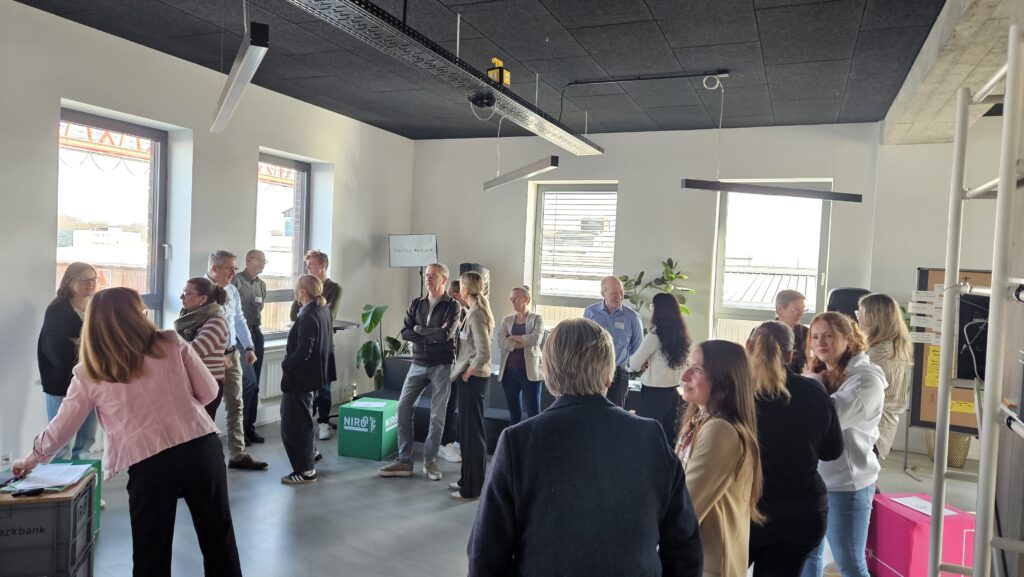
Once again, we welcomed numerous HR and training managers from our member companies to our second NIRO Personnel Day in the Hafenraum. Following last year’s successful premiere, this time the focus was on a particularly practical topic: conflicts in organizations.
“Peace, joy, puff cake” described how conflicts come to light. We explored the extent to which they influence our everyday working lives.
One thing was clear from the outset: things rarely run smoothly at work. Conflicts are part of it, occur at different levels and challenge us in changing roles. This makes it all the more important to be able to deal with them confidently and constructively.
Our Managing Director Ingrid Lange welcomed the group and introduced a brief spotlight on the topic of cross-mentoring at NIRO.
After an initial round of introductions, we presented our thoughts on possible cross-mentoring in our network in order to explore the benefits, opportunities and challenges of such a program among our members. There is interest in principle, but the framework conditions need to be examined in more detail. To this end, a workshop on cross-mentoring will be held in the summer for all interested parties.
The interactive workshop with Dr. Brigitte Schwinge from p4d | partnership for development GmbH then began.
First, we were allowed to position ourselves in the room to answer a few questions about dealing with conflicts in the company and it became clear at a glance, for example, that the majority of the group seeks to talk to friends and family at the end of a conflict-ridden day in order to generate positive energy.
As the workshop progressed, the focus was not only on scientific findings, but also on practical approaches and sharing ideas with one another.
We learned more about the different levels of conflict, escalation stages and conflict styles and how they can be recognized and classified. We discussed successful strategies for dealing with conflicts and at what stage of escalation intervention is still possible.
Finally, Dr. Schwinge introduced us to the p4d conflict navigator as an approach for dealing with disruptions and conflicts in the work context. On a personal and cultural level, individual steps can be traced that lead to conflicts being seen as an opportunity and a culture of conflict being established within the company. In this way, joint cooperation can be defined and shaped without ignoring conflicts or allowing them to smoulder.
The participants were able to take away the “conflict navigator” as a practical tool and many tips. The joint reflection and exchange in the plenary session made it clear that there is a desire to explore the topic in greater depth. We are planning another workshop on dealing with conflicts in the fall.
Many thanks to Dr. Brigitte Schwinge for the inspiring and interactive design of the workshop and to everyone who attended for their openness and lively exchange.