Have you ever heard of AI agents? I’m sure you have—the hype just keeps going.
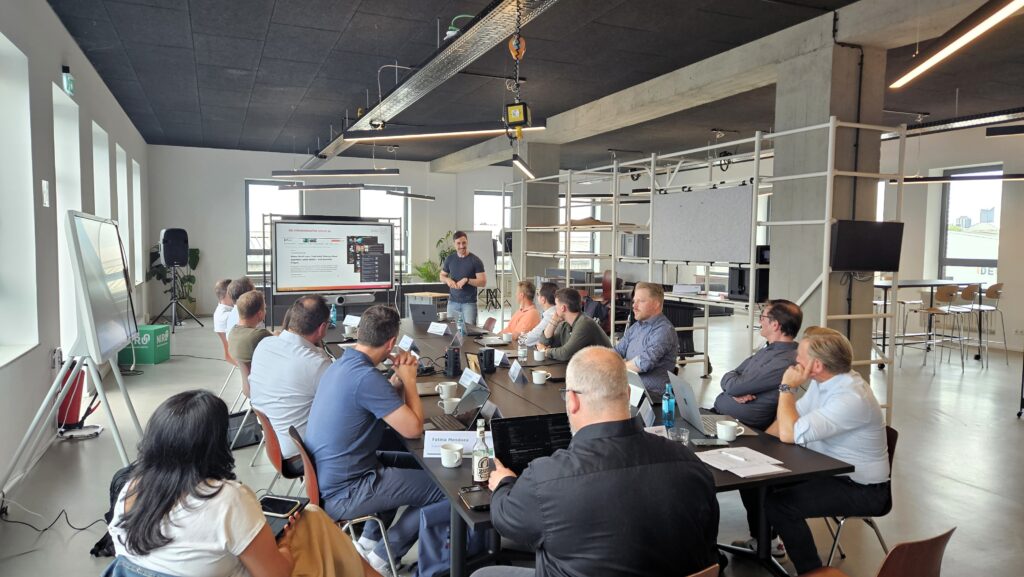
In an in-depth workshop on this topic held on June 8, 2026, we explored what AI agents are all about and how they work.
Our workshop was designed for participants who already had a basic understanding of AI and wanted to delve deeper into the technical aspects. It was led by Marco Fries from the Zukunftszentrum AI NRW, who gave us a hands-on introduction to the world of (open-source-based) AI agents.
This demonstrated that AI agents go far beyond traditional AI applications. While conventional systems are usually limited to individual tasks, AI agents can act independently, make decisions, and link multiple steps together in a goal-oriented manner. They combine language models with other components such as tools, data sources, or interfaces, enabling complex, automated processes.
The focus was initially on the technical fundamentals. AI agents are based on modern AI systems in which models, data, and platforms work closely together. The ability to control external tools and iteratively improve results is particularly crucial.
The use of AI agents requires a high-performance infrastructure—ranging from suitable computing resources to well-designed data flows and interfaces.
It is important to clearly distinguish AI agents from automated processes. Traditional AI-supported automation follows fixed rules. AI agents, on the other hand, act more flexibly, can make context-aware decisions, and independently determine the next steps to take.
However, oversight and verification remain essential here as well, and agents still do not act on their own—they absolutely require a “trigger” to activate them and begin their task.
Many participants were concerned with the question of how to implement a vendor-independent, data-sovereign AI system based on open source. Open source enables transparency and adaptability, and—with the appropriate hardware—also allows for local operation, potentially for applications involving sensitive and proprietary corporate data.
During the discussion that followed, it became clear that AI-powered automation can often be more than sufficient for certain tasks. Not everything that is technically possible or recommended by consultants needs to be implemented: The key question is: Who has the expertise to implement something like this?
Many thanks to Marco Fries for sharing his knowledge in such a varied and engaging way, to the Zukunftszentrum NRW for enabling us to offer workshops like this free of charge, and to everyone who attended for the open discussion, which this time opened up new perspectives on the practical use of AI agents.