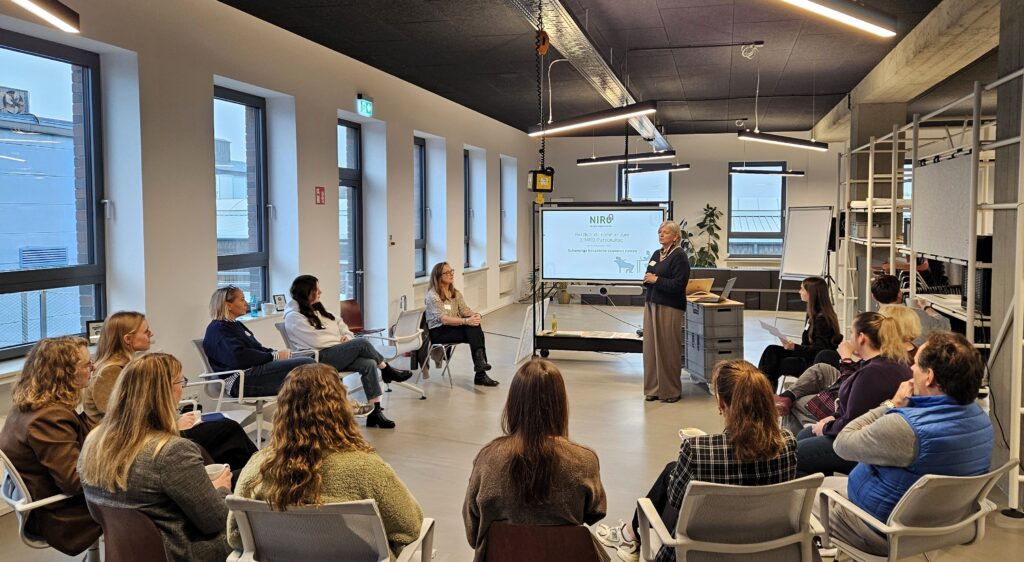
How do I bring up an issue that needs to be addressed without making an already difficult conversation even harder? The third NIRO HR Day focused on situations that HR and training managers know all too well from their day-to-day work.
Resolving conflicts, clarifying expectations, addressing inappropriate behavior, or clearly defining one’s own role: Difficult conversations require clarity regarding roles, attitude, and tact.
This was precisely the focus of our HR Day on November 11, 2026. Led by Dr. Brigitte Schwinge of p4d | partnership for development, the event not only focused on effective communication skills but, above all, provided an opportunity to practice how to make these conversations successful.
The focus was on the SAG ES! model as a practical framework for clarification discussions. It helps participants address difficult topics in a structured way, clearly articulate their own perspectives, and still remain engaged in dialogue. After a brief introductory session, the group quickly moved on to practical exercises: Participants practiced conversation scenarios, switched perspectives, and provided each other with structured feedback.
A case study developed specifically for this purpose illustrates just how quickly HR managers can find themselves caught in the middle: A student working part-time at the company wants to take on more responsibility, but her supervisor doesn’t yet believe she’s ready for this step. The HR manager gets caught in the middle and is expected to mediate.
But where does support end and partisanship begin? It became clear more than once just how challenging and emotionally taxing it is to remain composed, even in difficult conversations.
It is important to keep in mind not only the conversation itself, but also your own role in it. The SAG ES! model provides a clear structure and serves as a helpful guide.
Once again, the open exchange among participants was at least as important as learning about suitable methods. Already during the introductory round, the group identified key challenges. Discussing these issues in small groups and as a whole group—and seeing how other HR and training managers handle similar situations—opened up many new perspectives and demonstrated that one is rarely alone when it comes to difficult conversations.
A heartfelt thank you to Dr. Brigitte Schwinge for once again providing expert and practical guidance, and to all the participants for their openness, their insights, and their willingness to engage with the exercises.