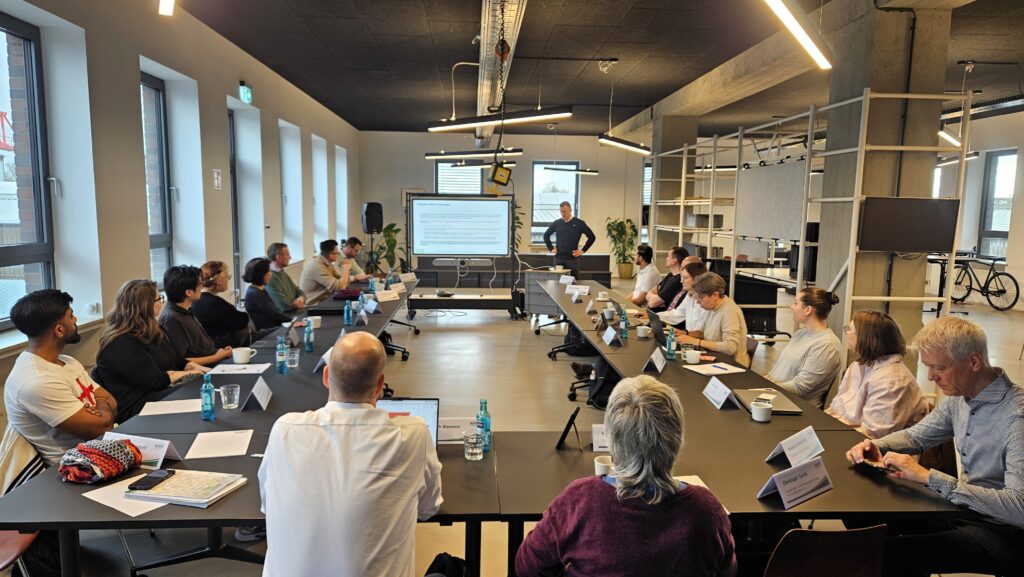
This time we met to discuss selected topics that play an important role in technical documentation: It was generally about editorial systems, the legal conformity of documents and a good practice example from the field of translation management.
We deliberately expanded our group for the third meeting on March 25, 2026: In addition to the members of the working group, we also invited managers from companies who are involved in the committee accompanying Christian Koch’s UniDoku research project.
This morning was a compact program with various impulses and a good practice example.
At the beginning, Christian Koch from the IPS at TU Dortmund University gave us a brief overview of the current status of the project. The maturity model for technical documentation developed there, in which our working group participated, can now be used in the web version: https://unidoku-ips.streamlit.app/
Christoph Beenen from Kothes GmbH kicked off the rest of the content. He gave us an overview of how modern editorial systems work, the advantages of using them and the importance of taking individual requirements into account when introducing them. He also made it clear that the tasks of technical editorial teams are increasing. Complex interrelationships, new regulatory requirements, faster content creation, different distribution channels and ensuring consistency, correctness and comprehensibility all need to be reconciled. Artificial intelligence can provide some support here. However, it is important to clarify in advance which tools are useful, where their use is worthwhile and which AI agents could improve the workflow in the future.
This was followed by a good practice presentation by Katrin Fomm from WILO SE, who provided interesting insights into her translation and technology management department. It was particularly impressive to see how the orchestration of different tools can lead to holistic implementation and the extent to which clear terminology is crucial for success
Roland Schmeling from Schmeling + Consultants GmbH provided a third impulse on the topic of legal compliance. Here it was of interest how technology and product law set certain requirements for technical documentation. A new dimension is opening up with the overarching transparency that the Digital Product Passport (DPP) will bring as a central instrument for product safety law issues. The changes under the new EU Machinery Regulation were also discussed.
Many thanks to everyone who contributed an impulse and shared their knowledge and experience with the group, and to all participants for the lively and open exchange.
We will soon be looking for a follow-up date for our working group in late summer.