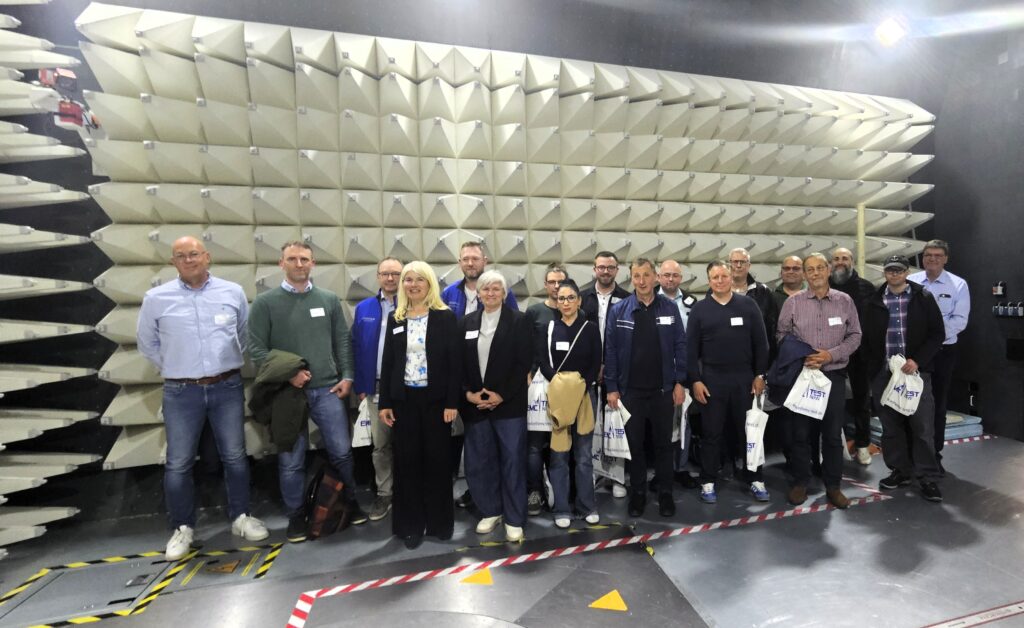
CE marking is currently at the top of the list for many of our member companies, as the new EU Machinery Regulation is just around the corner.
That’s why we visited EMC Test NRW GmbH in Dortmund on May 7, 2026 to take an in-depth look at the current requirements for CE marking.
This afternoon, the focus was on the upcoming changes brought about by the new EU Machinery Regulation, which will gradually come into force and will be mandatory from January 20, 2027. It replaces the previous Machinery Directive 2006/42/EC.
During our visit, it became clear that the CE marking is much more than just a sticker on a product. Manufacturers and distributors are responsible for ensuring that products are safe and meet all legal requirements – from standards research and technical documentation to the legally compliant EU Declaration of Conformity.
To kick things off, Ema Ziga, Managing Director of EMC Test NRW GmbH, introduced us to her company. EMC Test NRW is an independent competence center for electromagnetic compatibility (EMC) and supports companies in testing, certification and development processes relating to CE and EMC requirements. Among other things, industrial systems, vehicle components, high-voltage systems and electronic products of all kinds are tested there.
The technical input from Jörg Bärenfänger, Managing Director of EMC Test NRW GmbH, was particularly instructive as he gave us an understanding of the complex work of the modern EMC test laboratory. In the jungle of directives and standards, he dealt with the legal framework conditions and contexts that affect CE marking in Europe. He also referred to the Radio Equipment Directive, which applies to devices that communicate or locate wirelessly. The conformity of many new products with this directive will become increasingly important in the future.
The tour of the impressive test halls was a real highlight. Most of our group were particularly impressed by the large absorber hall: a specially shielded room in which electromagnetic interference can be measured and also generated. There it was clearly explained how products are tested for electromagnetic compatibility and why these tests are essential for safety, approval and marketability. We were able to understand the dimensions using a very large combine harvester from a well-known manufacturer, which underwent tests
The visit was extremely informative for everyone involved and offered exciting insights into a subject area that is becoming increasingly important for many companies.
We would like to thank Ema Ziga and Jörg Bärenfänger from EMC Test NRW GmbH for the open atmosphere, the interesting insights and the professional exchange!