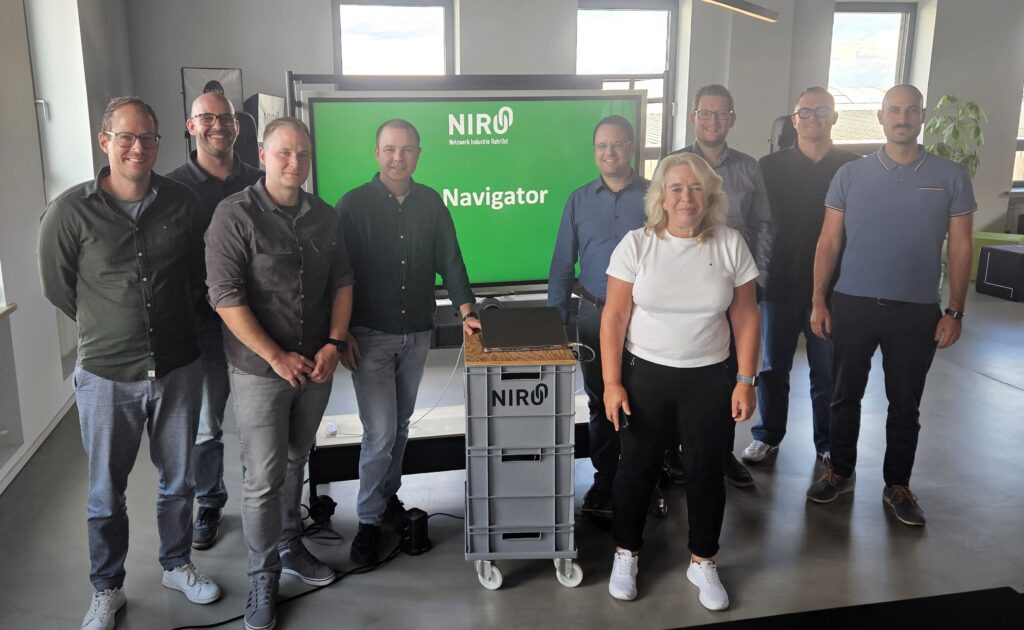
The “AI Masterclass,” which included our AI Navigator sessions, has come to an end. On September 9, 2026, our group met for the last time in its current configuration to document our findings, review what we had learned and implemented, take stock of our progress, and look ahead to the future.
After about half a year, four joint workshops, several online meetings, and the joint wrap-up, one key outcome has been established. In terms of content, the guide is complete following the wrap-up; all that’s left is the final revision. Then our AI Navigator will be available in an online version.
In February 2026, we launched our AI Navigator together with AI leaders from 12 member companies. The basic idea: to evaluate and potentially implement individual AI projects and to develop a practical tool that guides companies from the initial AI concept through to ongoing operations.
The KI Navigator group received scientific support from the Institute for Production Systems (IPS) at TU Dortmund University, which also provides our network with a high level of expertise in other key areas and is itself a member of NIRO.
After numerous meetings, we have developed a practical guide that explains how participants approached specific challenges and what factors should be taken into account when planning an AI project within one’s own company.
Initially, the focus was on theory and fundamentals: Which tasks are suitable for AI, which methods are viable, and why do projects fail? Building on this foundation, the participants presented their own projects—ranging from document processing and production know-how to AI strategy. Subsequent meetings addressed data quality, solution approaches, roles, acceptance, legal and governance issues, piloting, and future operations.
Specific tasks included, for example, transferring relevant content from customer specifications into an internal format in a structured manner, verifying it, and checking for required information,
contradictions, and outstanding issues.
For another company, the goal was to simplify the creation and use of service reports. The key question here was: How can this information be captured and processed in a user-friendly manner to structure and classify free-text data and make it analyzable for subsequent processes—ideally in multiple languages.
Other tasks involved creating work plans from ERP data based on previous planning or, for logistics, optimizing container planning and scheduling for reusable containers and their delivery.
Not every project was implemented exactly as originally planned. Some were reworked as the project progressed, while others were deliberately postponed—for example, because the data set was not yet sufficient, coordination with the works council was necessary, or implementation capacity was lacking. This, too, is a valuable outcome, as these very experiences highlight what to look out for before getting started.
At the final meeting on September 9, 2026, the participants took stock: What has been achieved since February, what concrete results are available, and what lessons can help other companies?
Collaborative learning, the valuable exchange of experiences, and the realization that we have set something in motion are what define our AI Navigator. The group plans to continue meeting.
The result—which will also be made available to other members—is the online AI Navigator, designed as a practical guide. We’ll let you know as soon as it’s ready. After all, nothing beats tried-and-true practices that can be applied to your own projects.
At this point, we’d like to extend a heartfelt thank you to our colleagues at IPS, who used their expertise to show us the most sensible path forward and helped us realize that not everything has to be solved with AI. Sometimes, simply automating individual processes very effectively is enough.
And many thanks to all the navigators who contributed with great dedication and worked on our joint AI Navigator right up to the very end.
This guide is intended to support AI decision-makers in our member companies in making a structured, step-by-step decision regarding an AI application and successfully implementing it.